


AR700 Laser Displacement Sensor
The AR700 is Acuity's most accurate laser triangulation sensor, measuring to within fractions of a micron at up to 9,400 Hz. Fifteen models cover spans from 3.2 to 1,270 mm (0.125 to 50 in), with linearity of ±0.03% of span on most models and resolution down to 0.16 µm. Every model has digital and analog outputs.

- Spans, mm
- 3.2–1,270
- Linearity, % of span
- ±0.03%
- Best resolution
- 0.16 µm
- Sample rate
- 9.4 kHz
- Enclosure
- IP67
AR700 Accuracy to Fractions of a Micron
Designed for industrial and scientific applications, the AR700 measures distances to within fractions of a micron at speeds near ten kilohertz.
Sub-micron resolution
Resolution of 0.005% of span, down to 0.16 µm on the AR700-0125, with linearity of ±0.03% of span on most models.
Fifteen spans, four case sizes
From 3.2 mm (0.125 in) to 1,270 mm (50 in). The model number is the span in inches, and four aluminum case sizes cover the range.
Options for tough targets
A 25 mW Class 3B laser keeps sample rates up on dark surfaces and in bright light. An internal bandpass filter helps outdoors and on bright or radiating targets.
Digital and analog outputs
RS232 and RS422 serial, a 4–20 mA or 0–10 V analog output and two NPN limit switches on every model.
AR700 models: where each one measures
The model number is the span in inches. Each span is centered on its standoff, the distance from the sensor face where accuracy is greatest and the laser spot is smallest (±0.25 mm tolerance).
AR700 vs. AR200
| Spec | AR700 | AR200 |
|---|---|---|
| Models and spans | 15 models, 3.2–1,270 mm | 5 models, 6.35–101.6 mm |
| Linearity | ±0.03% of span on most models | ±0.1% of range |
| Resolution | 0.005% of span, to 0.16 µm | 0.03% of range, to 1.9 µm |
| Sample rate | Up to 9,400 Hz | Up to 1,250 Hz |
| Laser | Red; Class 2, 3R or 3B | Red, Class 2 |
| Outputs | RS232 and RS422; 4–20 mA or 0–10 V; 2 NPN limit switches | RS232; 4–20 mA, 0–10 V or 2 NPN or PNP limit switches |
| Enclosure | NEMA 4, IP67 | NEMA 4, IP65 |
| Operating temp | 0 to 40 °C | 0 to 60 °C |
| Choose it when | You need the highest accuracy, finer resolution or spans past 100 mm | You want a cost-effective, non-contact replacement for an LVDT or contact gauge |
AR700 Full Specifications
Show full AR700 specs
| Models | AR700-0125, -0250, -0500, -1, -2, -2LR, -4, -6, -8, -12C, -12, -16, -24, -32, -50 |
|---|---|
| Span | 0.125 to 50 in (3.175 to 1,270 mm); the model number is the span in inches |
| Standoff | 12.7 mm (AR700-0125) to 1,422 mm (AR700-50), sensor face to middle of span; ±0.25 mm tolerance |
| Linearity | ±0.03% of span at 500 Hz, white target (85% diffuse reflectance); ±0.05% on AR700-32 and ±0.1% on AR700-50. On the -24, -32 and -50, these use the optional Class 3B diode. |
| Resolution | 0.005% of span (0.16 µm on AR700-0125 to 63.5 µm on AR700-50) |
| Laser spot size | 30 µm (AR700-0125) to 300 µm (AR700-50) |
| Sample rate | 0.2 to 9,400 Hz, or sample trigger (serial command or analog) |
| Laser | Visible red: 650 nm, 1 mW (Class 2); 670 nm, 5 mW (Class 3R); or 660 nm, 25 mW (Class 3B), depending on model |
| Serial outputs | RS232 full duplex; RS422 unterminated and terminated |
| Analog output | 4–20 mA or 0–10 V |
| Limit switches | Two, NPN, 100 mA sinking |
| Power | 15–24 VDC (−5% to +10%), 120–200 mA, 350 mA surge at power-up |
| Enclosure | NEMA 4, IP67; aluminum case |
| Operating temp | 0 to 40 °C (32 to 104 °F) |
| Storage temp | 0 to 60 °C (32 to 140 °F) |
| Case sizes | 82.6 × 54.0 × 28.6 mm (AR700-0125 to -2, -4); 132.1 × 54.0 × 28.6 mm (-2LR, -6, -8, -12C); 256.5 × 63.5 × 38.2 mm (-12, -16); 485 × 63.5 × 38.2 mm (-24, -32, -50) |
| Weight with cable | 370 g, 425 g, 1,225 g or 2,146 g by case size |
| Cable | 5 m standard (sold separately); 2, 10 and 15 m available; 12-conductor polyurethane; straight (standard) or 90° (optional) connector |
| Compliance | RoHS; 21 CFR 1040, IEC/EN 60825-1 |
Build Your AR700
Choose your model, laser, options, connections and accessories in five steps. Your choices carry over to the contact form.
AR700 Applications: Where Customers Use It
From battery labs to propeller shops and drilling rigs, customers use the AR700 when the measurement has to be exact.
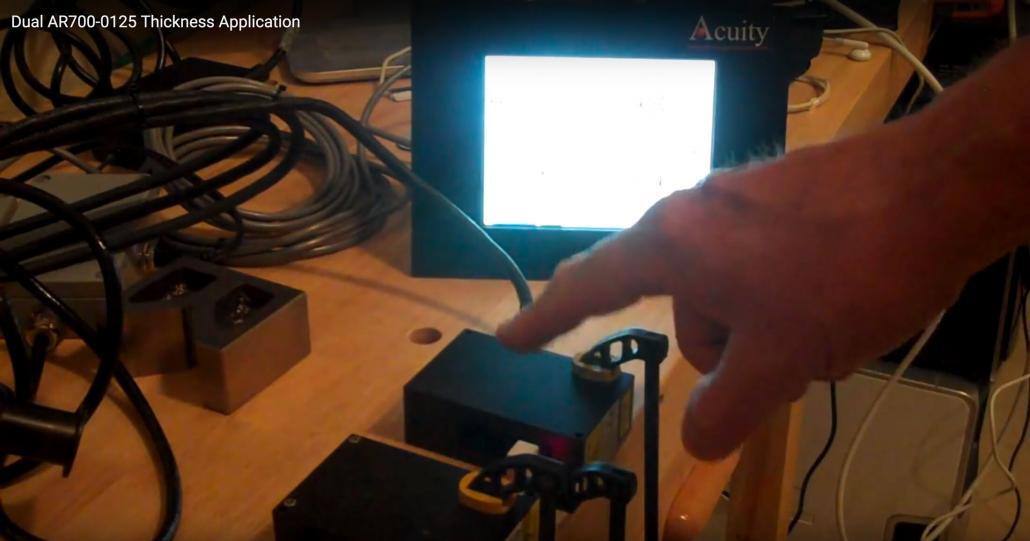
Sub-micron thickness
Two AR700-0125s and a Touch Panel Display measure a 10 mm gauge block, reading between 9.9993 and 9.9997 mm.
Sub-micron thickness measurement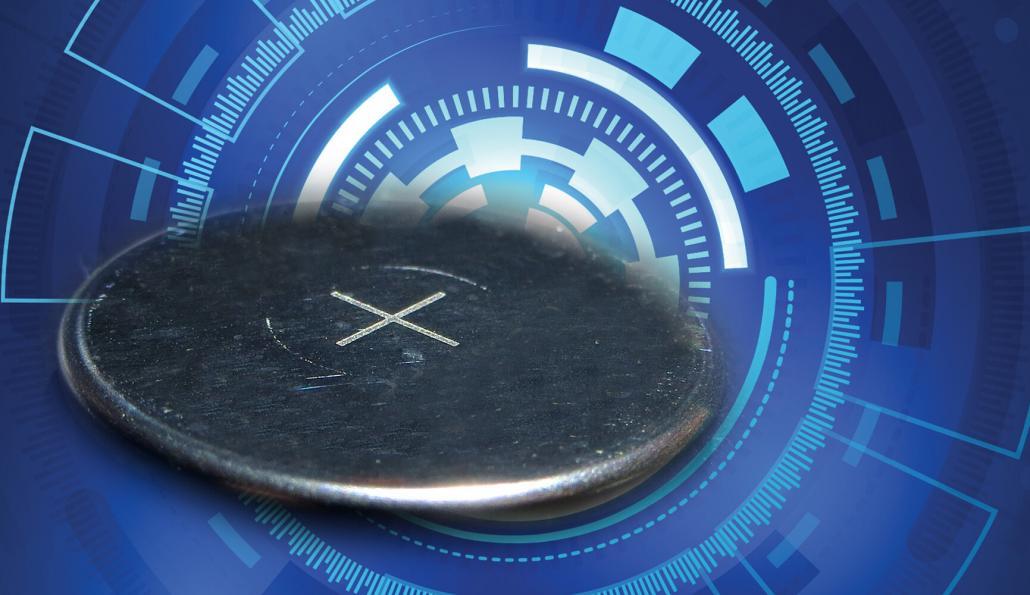
Battery expansion testing
Three AR700-0125s track how battery cells expand under cycling and pressure, logged by a Touch Panel Display.
Battery expansion test
Propeller blade profiling
A propeller maker profiles blades during manufacturing, and the AR700 handles their shiny, ground finish.
Propeller blade profiling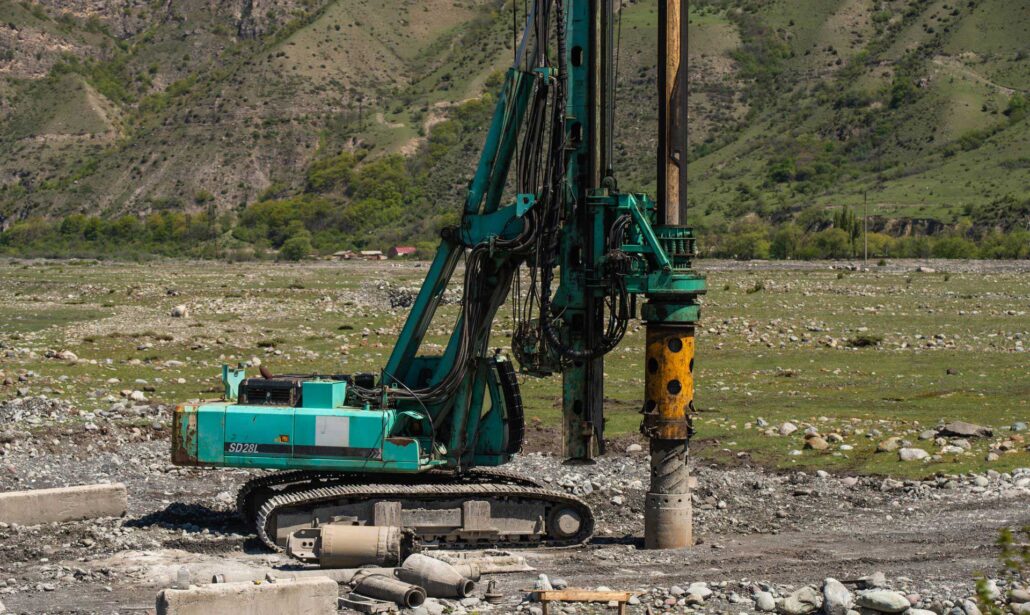
Drill string whirl
Three AR700-16s, 120 degrees apart around the drill collar, measure the speed and direction of lateral whirl.
Detection of drill string whirlAR700 Laser Displacement Sensor FAQs
What is the AR700?
The AR700 is Acuity's most accurate series of laser triangulation sensors. Fifteen models cover spans from 3.2 to 1,270 mm (0.125 to 50 in), with linearity of ±0.03% of span on most models, resolution down to 0.16 µm and sampling up to 9,400 Hz. Every model has digital and analog outputs.
How does the AR700 measure distance?
It uses laser triangulation. The sensor projects a laser spot onto the target, and a CMOS detector array inside views the reflected light from an angle. Its microprocessor calculates the distance from the image and sends it over the serial and analog outputs.
What is standoff on the AR700?
Standoff is the distance from the sensor face to the middle of the span. Accuracy is greatest there and the laser spot is smallest. The span extends half its length on either side of the standoff, and the AR700's standoff tolerance is ±0.25 mm.
Which AR700 model do I need?
The model number is the span in inches. Pick the smallest span that covers your target's full movement, because linearity and resolution are a percentage of the span. Then check that your target sits in that model's window, measured from the sensor face: AR700-0125, 11.1 to 14.3 mm; AR700-0250, 15.9 to 22.2 mm; AR700-0500, 25.4 to 38.1 mm; AR700-1, 38.1 to 63.5 mm; AR700-2, 60.5 to 111.3 mm; AR700-2LR, 132.1 to 182.9 mm; AR700-4, 77.7 to 179.3 mm; AR700-6, 177.8 to 330.2 mm; AR700-8, 203.2 to 406.4 mm; AR700-12C, 228.6 to 533.4 mm; AR700-12, 279.4 to 584.2 mm; AR700-16, 330.2 to 736.6 mm; AR700-24, 787.4 to 1,397 mm; AR700-32, 660.4 to 1,473.2 mm; AR700-50, 787.4 to 2,057.4 mm. Not sure? Contact us with your target and distance.
How accurate is the AR700?
Linearity is ±0.03% of span on the AR700-0125 to AR700-24, ±0.05% on the AR700-32 and ±0.1% on the AR700-50, measured at 500 Hz to a white target with 85% diffuse reflectance. On the -24, -32 and -50, those figures use the optional Class 3B diode; the standard 5 mW diode gives a larger linearity figure. Resolution is 0.005% of span. On the AR700-0125, that's ±0.95 µm linearity and 0.16 µm resolution.
How fast does the AR700 measure?
From 0.2 to 9,400 samples per second, or on a sample trigger by serial command or analog input.
What outputs does the AR700 have?
Every AR700 has RS232 full-duplex serial, RS422 serial (unterminated and terminated), a 4–20 mA or 0–10 V analog output, and two NPN limit switches that sink up to 100 mA.
Which laser should I choose?
All AR700 lasers are visible red: 650 nm at 1 mW (Class 2), 670 nm at 5 mW (Class 3R) or 660 nm at 25 mW (Class 3B). The classes offered depend on the model: Class 2 only on the AR700-0125 to -1; Class 2 or 3R on the -2; Class 2, 3R or 3B on the -4; and Class 3R or 3B on the -2LR and the -6 to -50. The 25 mW Class 3B upgrade gives high sample rates on dark surfaces or in high ambient light.
Is the AR700 laser eye-safe?
Class 2 models (1 mW) are considered safe for brief, accidental exposure because the eye's blink reflex limits it, but you should not stare into the beam. Class 3R and 3B models are more powerful: avoid eye exposure to the beam, and use certified eye protection with Class 3B.
Can the AR700 work outdoors or on bright targets?
Yes, with options. An internally installed bandpass filter is suggested for outdoor applications and for bright or radiating targets, and the 25 mW Class 3B laser helps in high ambient light. The aluminum case is rated NEMA 4 and IP67, and the operating temperature is 0 to 40 °C (32 to 104 °F).
Can the AR700 do road profiling?
Yes. A road profiling package for the AR700-6 or AR700-8 adds specialized optics, an upgraded diode, a bandpass filter and signal processing firmware optimized for high-speed longitudinal road surface profiling.
What is the AR700 used for?
Customers use it for sub-micron thickness measurement with two sensors, battery expansion testing, propeller blade profiling and drill string whirl detection. Other uses include copper, board and wooden door thickness, rubber measurement and alignment systems.
What accessories and cables are available for the AR700?
A Touch Panel Display that configures Acuity sensors and calculates material thickness from two sensors, with no PC or software development needed; a Connectivity Kit with terminal blocks, a molded DB9 serial cable and a 110 or 240 VAC power supply; and cables in 2, 5, 10 and 15 m lengths (5 m is standard, sold separately) with a straight or 90° connector.
What's the difference between the AR700 and the AR200?
Both use a red laser and offer RS232, analog and limit switch outputs. The AR700 is more accurate (±0.03% vs. ±0.1% linearity), resolves finer detail (0.005% vs. 0.03% of span), samples faster (9,400 vs. 1,250 Hz) and covers spans up to 1,270 mm. Choose the AR200 when you want a cost-effective, non-contact replacement for an LVDT or contact gauge.
Tell us about your application
Share your target, span, accuracy and output in our contact form. An Acuity engineer will confirm the right model and laser and send a quote.
What to include
- Target material and finish
- Span and distance
- Accuracy you need
- Output you need
- Quantity
- Company and contact
Your setup carries over to the contact form. Add these details in the message.