Acuity Laser > Short Range Sensors – Laser Distance Sensors
Last Updated: November 20, 2026
Short-Range Laser Triangulation Sensors
Short-range laser sensors measure distance, displacement, position and thickness without contact, using laser triangulation. Acuity makes five: the AR100, AR200, AR500, AR550 and AR700, with measuring ranges from 2 mm to 1,270 mm (50 in), linearity to ±0.03% of range and sampling up to 70 kHz.
Acuity Laser is the leading provider of precision laser sensors for distance and thickness measurement. Manufacturers, system integrators and OEMs have used Acuity sensors since 1992.
Filter all 44 Acuity short-range models by measuring range, base distance, linearity, resolution and speed. Tick the models that fit and request a quote for them.
1Enter your parameters Range, standoff, accuracy, speed
2Compare matching models Sort any column, open datasheets
3Get a quote Tick models, send them to sales
Series
Range is the measuring span. Base distance is from the sensor face to the start of the range. Linearity and resolution are shown in µm for each model. Blue lasers (AR100, AR500, AR550) help on glowing-hot targets and polished metals.
Showing 44 of 44 models
Acuity short-range laser triangulation sensor models. Select a column heading to sort.
Select
Laser class
Laser color
Ethernet
Enclosure
Downloads
*AR700-24, -32 and -50 linearity uses the optional Class 3B laser. Linearity for the AR550 is rated at 500 Hz on a white target. Red lasers are 660 nm (AR200: 650 nm; AR700: 650, 670 or 660 nm by laser class); blue lasers are 405 nm (AR500 and AR550: 405 or 450 nm). Specs from Acuity datasheets; confirm final details with an Acuity engineer.
Need help choosing?Show the matching models to compare and tick them, or send us your target, range and speed for a recommendation.
Acuity makes 44 short-range laser triangulation sensor models in five series (AR100, AR200, AR500, AR550 and AR700), measuring 2 mm to 1,270 mm. Full specs and datasheets are on each product page.
Five ranges from 6.35 to 101.6 mm (0.25 to 4 in), ±0.1% of range linearity (to ±6.35 µm) and up to 1,250 Hz, with analog, serial and two limit outputs standard.
Six ranges from 10 to 500 mm (0.39 to 19.7 in) in one 17 × 45 × 30.5 mm, 40 g housing, with linearity to ±0.05% of range, up to 9.4 kHz and a red or blue laser.
RS232 and RS422; 4–20 mA or 0–10 V; 2 limit switches
IP67
*AR700 linearity is ±0.03% of range on all models except the AR700-32 (±0.05%) and AR700-50 (±0.1%). Figures for the AR700-24, -32 and -50 use the optional Class 3B laser; the standard laser gives higher linearity values on those models.
Each model also has a base distance: the distance from the sensor face to the start of its range. AR700 datasheets list standoff, measured from the sensor face to the middle of the range. See each datasheet for details.
Red lasers are 660 nm, except the AR200 (650 nm) and the AR700 (650, 670 or 660 nm, depending on laser class). Blue lasers are 405 nm (the AR500 and AR550 also offer 450 nm) and help on glowing-hot targets and polished metals.
The sensor projects a laser spot onto the target. A lens images that spot onto a detector set at an angle. As the target moves closer or farther, the spot shifts along the detector, and that position gives the distance.
Triangulation is best for short ranges that need micron-level accuracy. Accuracy is highest, and the laser spot smallest, in the middle of the measuring range.
A laser triangulation sensor measures distance without contact. It projects a laser spot onto a target and reads where the reflected spot lands on an angled detector. It suits short ranges that need micron-level accuracy.
What measuring ranges do Acuity’s short-range sensors cover?
From 2 mm (AR550-2) to 1,270 mm (50 in, AR700-50). Range is the measuring span. Each model also has a base distance, the distance from the sensor face to the start of its range.
Which short-range sensor is the most accurate?
The AR700. Linearity is ±0.03% of range on most models, which is ±0.95 µm on the smallest model (AR700-0125), with resolution down to 0.16 µm.
Which short-range sensor is the fastest?
The AR550, at up to 70 kHz over Ethernet. The AR100, AR500 and AR700 reach 9.4 kHz, and the AR200 reaches 1,250 Hz.
How are short-range sensors different from long-range sensors?
Short-range sensors use laser triangulation and measure up to 1,270 mm (50 in) with micron-level accuracy. Acuity’s long-range laser distance sensors time laser light to the target and back, and measure up to 100 m on natural surfaces (500 m with a reflector) with millimeter-level accuracy.
Can these sensors measure thickness?
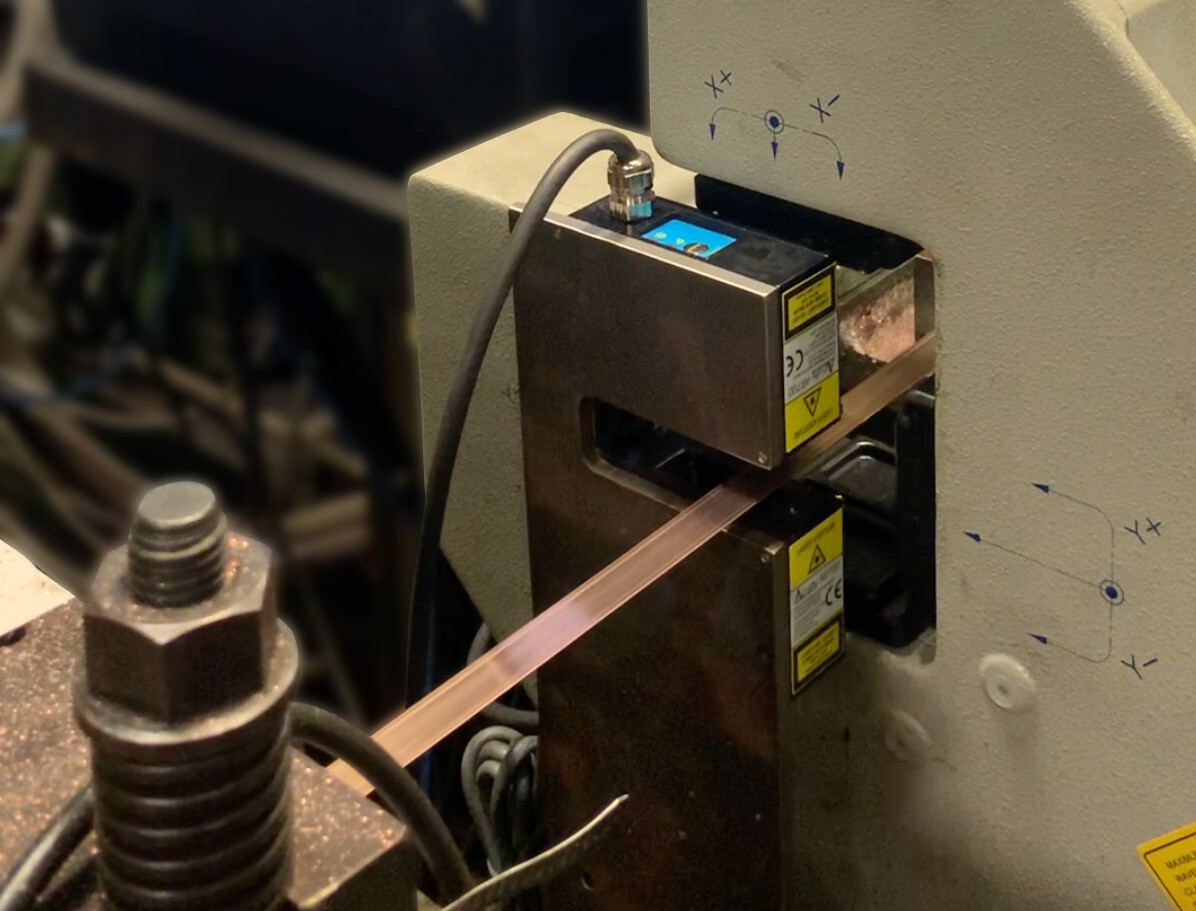
Yes. Mount two sensors facing each other on opposite sides of the material and subtract the readings. Acuity also builds pre-engineered laser thickness measurement systems that pair laser sensors with an industrial computer, set up for each customer’s line.
Can they measure hot, dark or shiny targets?
Yes, with the right options. Blue lasers (AR100, AR500, AR550) help on hot, glowing targets. Higher-power lasers (AR500, AR550, AR700) help on dark targets and in bright light, and the AR700 offers bandpass filters for high ambient light and radiating, dark or shiny targets.
Do they work in extreme temperatures or wet conditions?
The AR100, AR500, AR550 and AR700 are rated IP67, and the AR200 IP65. The AR500 and AR550 run from −10 to 60 °C (14 to 140 °F) as standard, with factory options for an internal heater (to −30 °C) and an air-cooled jacket (to 120 °C ambient). The AR500 also offers a spray guard.
Are they eye-safe?
The AR100 and AR200 use Class 2 lasers. The AR700 uses Class 2 on models up to 25.4 mm range, Class 2 or 3R on the AR700-2, Class 2, 3R or 3B on the AR700-4, and Class 3R or 3B on the AR700-2LR and models from 152.4 mm range up. The AR500 ranges from Class 2 to 3B, and the AR550 uses Class 3R or 3B. Class 3B lasers require certified eye protection.
What outputs do they support?
All five have serial and analog outputs. The AR100 and AR500 offer RS232 or RS485 with 4–20 mA or 0–10 V, and the AR500 has an Ethernet option. The AR200 has RS232, 4–20 mA or 0–10 V, and two limit switches. The AR700 has RS232 and RS422, 4–20 mA or 0–10 V, and two limit switches. The AR550 has Ethernet, 0–10 V and RS232 or RS485.
Can I synchronize multiple sensors?
Yes. The AR700 has a trigger mode for synchronizing multiple sensors. The AR100, AR500 and AR550 accept an external trigger for single measurements.
Can a laser sensor replace an LVDT?
Yes. Customers use the AR200 as a non-contact replacement for LVDT sensors, so nothing touches the part.
What if I need to measure longer distances?
Use a long-range laser distance sensor. Acuity’s long-range sensors measure up to 100 m (328 ft) on natural surfaces and up to 500 m (1,640 ft) with a reflector.
Not Sure Which Short-Range Sensor Fits?
Tell us your target, measuring range, accuracy and speed. An Acuity engineer will recommend a model and send a quote.