
Crane Positioning Systems with Laser Distance Sensors Posted in: Position Measurement, Updates – Tags: Automation, Position Measurement
Last Updated: November 10, 2026
Quick answer
To set up a crane positioning system, mount one laser distance sensor per axis of motion: bridge, trolley and hoist. Then add a reflective target at the far end of any axis that runs past the sensor’s natural-target range. Finally, connect the sensors to the plant’s PLC, where the positioning and anti-collision logic runs. This guide covers where each sensor fits, range and accuracy, reflectors, PLC connections and environmental factors.
How do you set up laser positioning and anti-collision on overhead cranes?
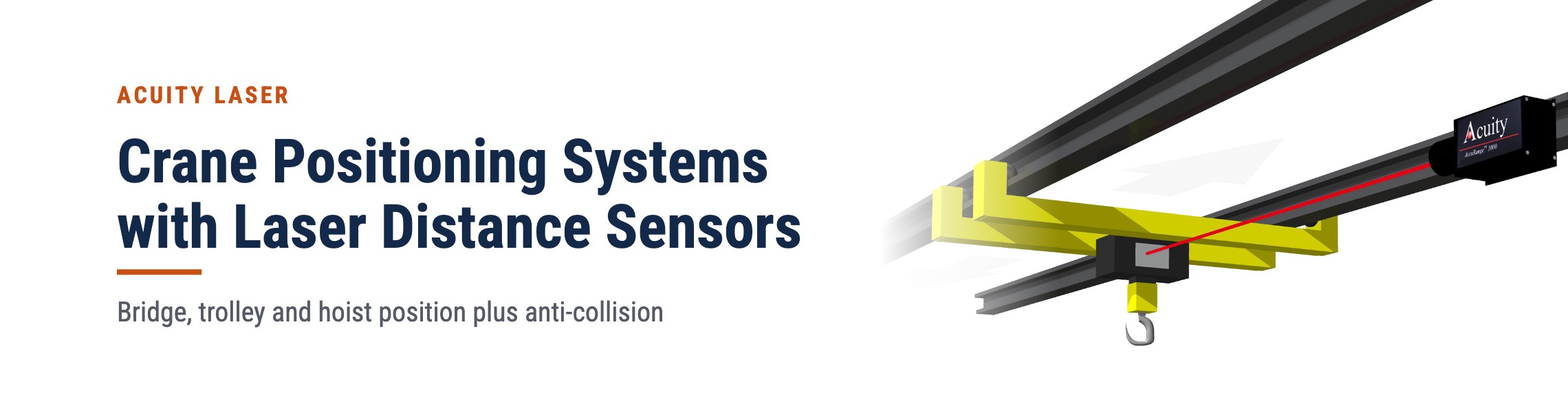
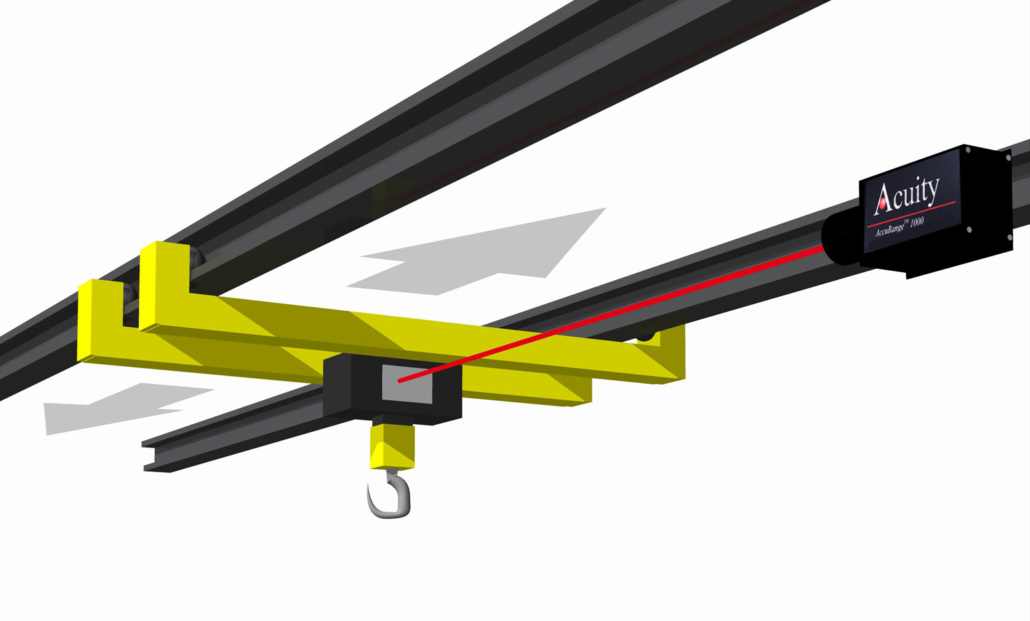
Crane positioning systems require understanding the layout. On a bridge crane, the crane rides the length of the building on rails, and a hoist travels on the trolley, lowering a hook or grabber to move loads. Automated cranes use several laser distance sensors, which commonly means one sensor per axis of motion.
When there’s long travel along tracks exceeding 100 meters, expect to use reflective targets for long runs. Retroreflective targets can greatly extend what each sensor can measure, so mount a reflector at the far end of each axis when distances exceed the natural-target range.
To prevent collision, the AR1000 Laser Distance Sensor can monitor side-to-side and vertical hoist positions and provide anti-collision assurance. For more on crane layouts, see our crane positioning guide.
Which laser sensors fit bridge, trolley and hoist positioning?
For long travel down the runway of bridge travel, buildings often run over 250 meters. For these long stretches, plants commonly use the AR2700 High-Speed Long Range Sensor to measure crane position along the runway. Meanwhile, the AR1000 laser distance sensor fits in by monitoring the side-to-side position and vertical hoist position of cranes as a reliable, cost-effective monitoring option.
The AR1000 also provides anti-collision assurance, acting as a crane proximity sensor. Because cranes need both crash avoidance and automated retrieval, plants often monitor their positions continuously. The collision logic itself commonly lives in the plant’s PLC, since the sensors connect to it through analog and serial outputs.
Example: steel mill coil storage
Steel mills store large coils of sheet stock on warehouse floors and move them with overhead bridge cranes. To automate pick-and-place, mills fit each crane with several laser distance sensors. An AR2700 covers the longest stretches of travel, while AR1000 sensors track side-to-side and vertical hoist position and provide anti-collision assurance. All of the sensors connect to the plant’s PLC through analog and serial outputs, which is how many mills retrofit manual-control cranes for automation.
Read the full overhead crane position measurement case study, or see our bridge cranes guide for seaport applications.
How do you choose sensor range and accuracy for a crane?
| Sensor | Description | Range | Accuracy | Sampling speed | Highlights |
|---|---|---|---|---|---|
| AR1000 Laser Distance Sensor | Acuity’s most cost-effective, rugged long-distance sensor | Up to 30 m (150 m on reflective targets) | ±3 mm | Up to 50 Hz | Internal heater version available, suitable for operation at -40 °C |
| AS1100 Long Distance Sensor | Rugged long-distance sensor for versatile environments, often used on hot materials | Up to 100 m (150 m with Acuity reflective plate) | ±3 mm | Up to 100 Hz | Measures glowing targets up to 1400 °C; Class 2 visible red laser; IP65; operating temp -10 to 50 °C |
| AS2100 Accurate Distance Sensor | Acuity’s most accurate long-distance sensor | Up to 100 m (500 m on Acuity reflective targets) | ±1 mm | Up to 250 Hz | Measurement on difficult targets, industry-leading accuracy |
| AR2700 High-Speed Long-Range Sensor | Acuity’s highest speed, long-range sensor | Up to 70 m (270 m with reflective targets) | ±60 mm | Up to 40 kHz | Eye-safe, infrared laser (Class 1); operating temperature -20 °C to +60 °C |
When do you need a reflector, and why do readings drop at long range?
You need a reflector once the distance goes beyond a sensor’s natural-target range. One of the key differences between the Acuity reflective plate and the reflective foil is size: the foil has roughly 11 times the plate’s area.
Note
To avoid damaging the laser, only use Acuity reflective targets with Acuity laser sensors.
How to align a laser with a reflector
Common recommendations for laser sensor alignment with reflective targets:
- Check the full travel: check the spot along the full travel, not just at one point.
- Use a visible beam: a visible red beam can be an alignment aid. For example, the Class 2 visible laser diode makes the AR1000 rangefinder easy to aim.
- Fine-tune the AS2100: the AS2100 bracket alignment unit allows ±4° of adjustment in two axes to fine-tune the aim at the target.
- Check for skew: place a separate laser and reflector near each end of the bridge. Comparing the two distances shows whether the bridge is square or skewed.
Why do readings drop at long range?
For laser sensors, readings drop at longer ranges because the returning light gets weaker the farther the target is. As a result, once the sensor can’t tell that echo apart from background noise, it first loses accuracy and then can’t measure at all.
How do crane position sensors connect to a PLC?
In our current long-range sensor lineup (the AR1000, AS1100, AS2100 and AR2700), every sensor offers 4–20 mA and serial connections. Only the AS1100 and AS2100 offer EtherNet/IP. For crane positioning system setups, plants often wire sensors straight into the PLC over analog and serial outputs.
Analog 4–20 mA
- Setting the span: Each sensor lets you choose which distances map to the bottom and top of the current range. For example, on the AR1000, the RB command sets the 4 mA point and RE sets the 20 mA point. The AS2100’s start and end points can be anywhere in the sensor’s range.
- Wiring for accuracy: For the AR1000, the 4–20 mA loop is most accurate with a 500-ohm load on the current-loop return at the measuring end.
- Error signaling: The current loop can flag a fault so the PLC knows a reading is bad:
- You can set the AR1000 to output 3 mA or 21 mA on error.
- You can set the AS1100 to any error value from 0 to 20 mA, for example 3 mA when the normal minimum is 4 mA.
Serial
- AS1100 / AS2100: Switching among RS-232, RS-422 and RS-485 takes one parameter change. Both also have a USB port for setup and troubleshooting.
- AR1000: You pick RS-232 or RS-422 hardware at purchase, and it stays fixed.
- AR2700:
- It includes both RS-232 and RS-422, but don’t connect and use them at the same time.
- Data comes out as ASCII in decimal or hex.
- It can also send its internal temperature and signal amplitude, which is useful for watching reflector alignment from the PLC.
- Cabling: Sensor cables come with flying leads to wire to whatever connector your PLC uses. Acuity also offers a connectivity kit with a power supply, a DB9 serial cable and a NEMA-4X interface box with terminal blocks.
EtherNet/IP (AS1100 and AS2100 only)
- Hardware: EtherNet/IP comes from a dedicated back cover, ordered as its own part number (AS1150010E or AS2150010E).
- Cables: The Ethernet version needs both a power cable and an Ethernet cable.
- Setup: See the AS2100 Getting Started with EtherNet/IP guide (PDF).
Discrete outputs (alongside the PLC link)
These are useful for hardwired slowdown or stop signals:
- AS1100: two digital outputs for limit monitoring plus a third that signals an error state.
- AR2700: two limit switches, sourcing up to 200 mA each.
- AR1000: an alarm output that can source up to 500 mA.
How do light, dust and heat affect a crane position sensor?
Many Acuity long-range sensors come in rugged NEMA-4, IP65 and IP67 housings for indoor or outdoor use. Even so, environmental conditions can always be a factor in laser measurement. Keep these recommendations in mind for your crane positioning system:
Replacing an existing crane laser?
If you’re looking at replacing an existing crane position sensor, or starting from scratch, reach out to Acuity Laser with some of these helpful details:
- The old model and part number.
- The distance and the target. Please list out:
- the full travel distance on each axis
- whether the sensor aims at a natural surface or a reflector
- The PLC interface.
- Speed and accuracy needs.
- Environment. Please note factors such as:
- temperature range at the mounting point
- sun exposure
- dust
- whether the target is hot material
- Laser type. A swap can change how the laser is aimed and checked.